A Pen-and-Paper Check Before You Name a Fictional Character
Test a fictional character name on the page, in dialogue, and beside other names to see whether readers can follow it and connect it to the right person.
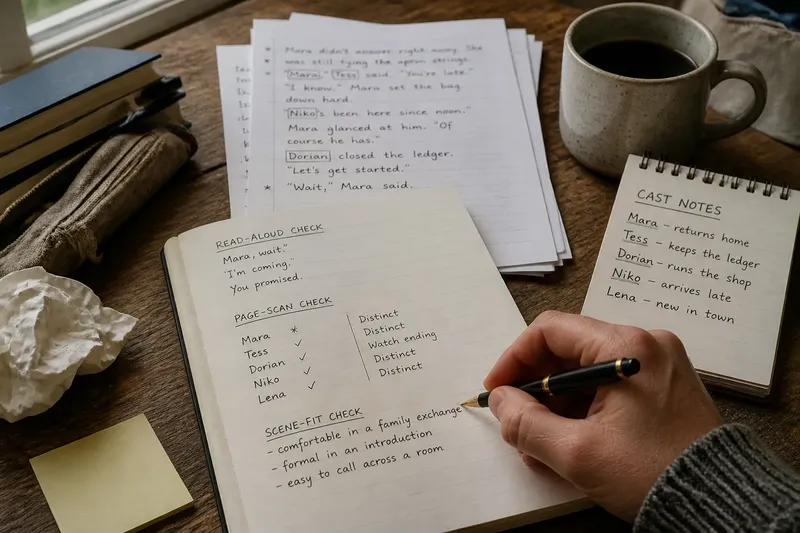
Will readers recognize your character’s name in a crowded scene, remember it after a chapter break, and believe it belongs in the story? A pen-and-paper check for a fictional character name lets you test those questions before the name spreads through a draft. You need a page, a pen, and a few lines from the scenes where the character matters.
There is no single best way to run the check. A quick read-aloud suits a name that looks fine but feels awkward in dialogue. A page scan helps when several characters appear together. A scene test is better when the name must carry a particular relationship, mood, or social role. Try the smallest test that answers your actual concern, then compare options only where the scene gives you a reason to.
Three useful approaches
Each approach examines a different kind of fit. None can tell you whether every reader will respond to a name in the same way; they can show you where the page itself creates friction.
- Read-aloud check: Write a short exchange that includes the name, then say it naturally. This suits names with unfamiliar letter patterns, several syllables, or a nickname that differs sharply from the formal version. Listen for a stumble, an unintended rhyme, or a line that sounds like the speaker is announcing rather than addressing someone.
- Page-scan check: Copy a few paragraphs containing the character and their closest scene companions. This suits ensemble casts, fast-moving dialogue, and names that share initials, endings, or visual shapes. Scan without reading closely and see whether the names separate clearly at a glance.
- Scene-fit check: Put the name into a moment that depends on the character’s role. This suits a name meant to feel intimate, formal, comic, distant, or tense in a particular relationship. Compare how it sounds in narration, a private exchange, and a public introduction.
Choose by the problem you are trying to solve. If you cannot tell whether the name works because you have not seen it in context, start with the scene-fit check. If the problem is spoken flow, read aloud before changing the spelling.
Read-aloud check
On paper, write a small exchange rather than repeating the name in isolation. Include a line of narration, a line of dialogue that uses the name, and a reply from someone who knows the character well. Then read the exchange at the pace the scene calls for.
Mark the spot where your voice hesitates. Ask whether the hesitation comes from the name itself or from the sentence around it. A long name may work easily in narration but crowd a clipped exchange. A nickname may sound natural between friends and strained in a formal conversation. The distinction matters: revising the sentence could solve a problem that changing the name would only disguise.
Next, try the name in different grammatical positions: at the start of a sentence, in the middle of a line, and in direct address. A name can flow smoothly in one position and snag in another. Check whether the spelling encourages the pronunciation you intend, but do not assume every reader will say it identically.
Imagine your character Mara is called by name during a hurried exchange with a sibling. If “Mara, wait” sounds natural but a formal introduction feels too casual, the issue may be the context rather than the name. Try the full name in the introduction and reserve Mara for familiar speech; note whether the distinction is clear on the page.
Page-scan check
Copy the paragraph or dialogue page where the character appears beside other named characters. Put a small mark beside every name, then look at the page without reading each sentence. Notice which names catch your eye and whether two seem to merge because they begin or end alike.
Compare names by shape as well as sound. “Mina” and “Mira” differ by one letter and can blur during a quick read. “Mina” and “Dorian” have more distinct outlines, though that alone does not make either a better choice. Look at the cast that actually shares scenes, not a list of every character in the book.
Try a second pass with the names covered by small slips of paper. Read the surrounding dialogue and see whether the speaker tags still make the exchange easy to follow. If two characters are repeatedly confused, check whether their names are too similar, whether the dialogue lacks clear turns, or both. A revised tag or a character action may be enough; the name is only one part of orientation.
Keep a short cast note beside the page. Write each name with one identifying detail that is already present in the scene, such as “Tess—keeps the ledger” or “Niko—arrives late.” If the note is hard to make distinct, the scene may need clearer characterization, not a more decorative name.
Scene-fit check
A name does not work in a vacuum. Its effect depends on who says it, where they are, and what they want from the character. Choose one scene where the character’s presence matters, then write the name into three versions of that moment: narration, speech from someone close, and speech from someone with authority or distance.
Look for a useful contrast, not one fixed emotional response. A formal name might create distance in a family argument and sound ordinary in a workplace introduction. A nickname might suggest ease in one relationship but feel pointed when used by someone who has no right to it. Decide what the scene supports before deciding what the name must signal.
Check the character’s own relationship to the name, too. Do they introduce themselves with it, accept a shortened form, correct other people, or avoid saying it? These choices can make a familiar name feel specific without requiring an elaborate backstory. Keep the behavior consistent enough that a reader can follow it, while leaving room for the character to respond differently in different settings.
Write down the scene’s practical demands in plain language: “easy to call across a room,” “comfortable in a family exchange,” or “distinct from the other speaker’s name.” Then compare your candidate against those demands. This keeps a vague sense of fit from turning into endless swapping between names.
What should you test?
How many scenes should I use?
Start with one scene that puts the name under the most pressure, such as a crowded conversation or a formal introduction. Add another only if the character’s name changes function across relationships or settings.
Should I test the full name or a nickname?
Test both if the draft uses both. Write down who uses each form and where it appears, then check that a reader can tell they refer to the same person without stopping to decode the change.
What if the name is unfamiliar to me?
Read it slowly, then place it in ordinary dialogue and narration rather than judging it as a string of letters. If pronunciation or cultural context matters to the character, seek informed guidance instead of treating your private first impression as a universal reaction.
When should I keep a name that feels difficult?
Keep it if the difficulty serves the character or setting and the surrounding prose helps readers identify the person. Revise when the same confusion repeatedly interrupts scenes without adding a deliberate effect.
Choose by scene
After the tests, compare no more than a few candidates on the same page. Write each name into the same lines, keeping the action and dialogue unchanged. That makes differences easier to notice: one may fit naturally in direct address, another may stand apart from the cast, and a third may suit the character’s formal role.
Use a simple paper grid with one row for each candidate and columns for “spoken aloud,” “easy to spot,” and “fits this scene.” Add a brief note in each cell rather than a score. For example, write “smooth in dialogue,” “too close to Mira,” or “works for the public introduction.” A note preserves the reason for your choice; a score can make a subjective impression look more exact than it is.
If two candidates work equally well, choose the one that makes the draft easier to read without asking the name to do all the character work. Voice, action, relationships, and context carry meaning too. A plain name can become memorable through what a character says and does; an unusual name cannot compensate for a scene that leaves the character indistinct.
Repeat the pen-and-paper check for a fictional character name when a name changes form, a new character joins the cast, or a revision moves the character into different kinds of scenes. Keep the page that helped you decide, along with the short reason you chose the name. That note gives you a clear reference when the draft later asks the name to do something new.